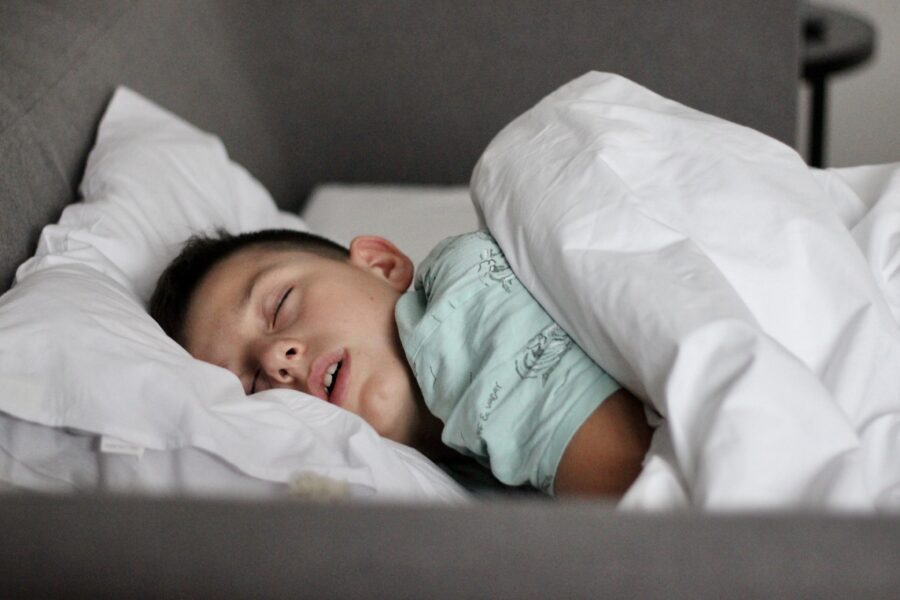
Occasional snoring during a cold is common and usually not a concern. Snoring deserves a closer look when it happens most nights, sounds effortful rather than simple and quiet, comes with witnessed pauses in breathing, or is accompanied by daytime signs like fatigue or trouble concentrating. Any one of these on its own may mean little; several together are worth discussing with a pediatrician.
This article is for general education and isn’t a substitute for an in-person medical evaluation.
What Causes Snoring in Children?
Snoring happens when airflow through the nose and throat is partially restricted, causing nearby tissue to vibrate. In children, this restriction can come from several sources, and more than one is often present at once.
| Category | Common Examples |
|---|---|
| Temporary/illness-related | A cold, seasonal allergies, sinus congestion |
| Anatomical | Enlarged tonsils or adenoids, a narrow palate, a smaller or recessed jaw, a deviated septum |
| Other contributing factors | Excess weight, sleep position (snoring is more common lying on the back) |
Most children who snore occasionally fall into the first category, and the snoring resolves as the congestion clears. Anatomical factors are more likely to produce a persistent pattern that doesn’t go away between illnesses.
Occasional Snoring vs. a Pattern Worth Evaluating
The distinction that matters isn’t whether a child has ever snored — most children do at some point. It’s whether snoring has become a consistent pattern rather than an occasional event tied to being sick. A single loud night during a cold is a different situation than snoring that shows up most nights, month after month, regardless of illness.
The Four Factors That Give Snoring Context
Snoring by itself is a limited piece of information. What actually helps a parent or provider judge whether it’s worth evaluating is the context around it — specifically these four factors.
| Factor | What to Notice | Why It Matters |
|---|---|---|
| Frequency | Does it happen most nights, or only occasionally with illness? | Frequent, illness-independent snoring points more toward an ongoing anatomical or structural cause rather than temporary congestion |
| Breathing effort | Is it quiet, steady breathing, or does it sound labored, effortful, or interrupted? | Labored breathing suggests the airway is more significantly restricted, not just producing background noise |
| Witnessed pauses | Have you observed actual pauses in breathing, gasping, or choking sounds during sleep? | Witnessed pauses are one of the more specific signs associated with obstructive sleep apnea in children, rather than simple snoring |
| Daytime concerns | Is your child unusually tired, irritable, or having trouble focusing during the day? | Daytime symptoms suggest the snoring may be disrupting sleep quality overnight, not just producing noise |
A child who snores occasionally, breathes quietly, and shows no daytime symptoms fits a low-concern pattern. A child whose snoring is frequent, sounds effortful, includes witnessed pauses, and comes with daytime fatigue or behavior changes fits a pattern that a pediatrician should evaluate directly, rather than something to continue monitoring at home.
When Should Parents Contact a Medical Professional?
Contact your child’s pediatrician if snoring happens most nights over a period of weeks, sounds labored or is unusually loud, is accompanied by witnessed pauses in breathing or gasping, or occurs alongside daytime fatigue, irritability, or difficulty concentrating. According to Cleveland Clinic, obstructive sleep apnea in children is associated with these same features — frequent snoring, breathing pauses, and disrupted daytime functioning — which is why a cluster of these signs, rather than snoring in isolation, is the more reliable indicator.
A pediatrician can examine your child, review the pattern you’ve observed, and determine whether a referral — commonly to an ENT (ear, nose, and throat specialist) for evaluation of the tonsils and adenoids, or to a sleep specialist for further testing — is appropriate. This is a medical evaluation, not something that can be confirmed from observation alone.
How Dental Screening Fits Into the Picture
A dentist trained in airway-focused screening can identify structural factors that may be contributing to snoring — such as a narrow palate, a smaller jaw, or a bite pattern that suggests reduced airway space — as part of a routine or airway-specific dental visit. This kind of screening is genuinely useful information: it helps explain why a child’s anatomy might predispose them to snoring or airway restriction, and it can support a more informed conversation with a pediatrician or specialist.
A dental airway screening is not a diagnosis of sleep apnea. Confirming obstructive sleep apnea requires a medical evaluation and, in many cases, a sleep study interpreted by a physician — it isn’t something an oral or airway exam alone can determine. When a screening identifies a pattern or structural finding that looks relevant, the appropriate next step is coordinating with your child’s pediatrician or a sleep medicine specialist, not treating the screening itself as a final answer. Our Airway & Sleep page describes this screening-and-coordination approach in more detail.
Frequently Asked Questions
Is it normal for a child to snore sometimes? Yes. Occasional snoring, especially during a cold or allergy flare, is common and doesn’t by itself indicate a medical problem.
How loud does snoring have to be before it’s concerning? Volume alone isn’t the deciding factor. Snoring that sounds labored or effortful, or that occurs alongside witnessed breathing pauses and daytime symptoms, is more relevant than loudness by itself.
Can a dentist diagnose sleep apnea in a child? No. A dentist can screen for structural factors — like palate width or jaw position — that may contribute to airway restriction, but diagnosing sleep apnea requires a medical evaluation, typically involving a physician and often a sleep study.
What happens after a pediatrician evaluates my child’s snoring? Depending on the findings, a pediatrician may recommend monitoring, allergy management, or referral to an ENT or sleep specialist for further evaluation of the tonsils, adenoids, or overall breathing pattern during sleep.
Does snoring always mean a child has sleep apnea? No. Most children who snore do not have sleep apnea. Snoring becomes more concerning when it’s frequent, effortful, accompanied by witnessed pauses, or paired with daytime symptoms.
Getting Started
If your child’s snoring fits a pattern worth a closer look — frequent, effortful, or paired with daytime symptoms — start with your pediatrician for a medical evaluation. If you’d like a dental airway screening to help understand whether jaw or palate structure may be a contributing factor, contact us or visit our Airway & Sleep page to learn more about how that screening works alongside your child’s medical care.
References
- Cleveland Clinic. Obstructive Sleep Apnea in Children. Cleveland Clinic Health Library. https://my.clevelandclinic.org/health/diseases/14312-obstructive-sleep-apnea-in-children
- Pediatric Obstructive Sleep Apnea: Diagnostic Challenges and Management Strategies. PMC, National Library of Medicine. https://pmc.ncbi.nlm.nih.gov/articles/PMC11649035/