
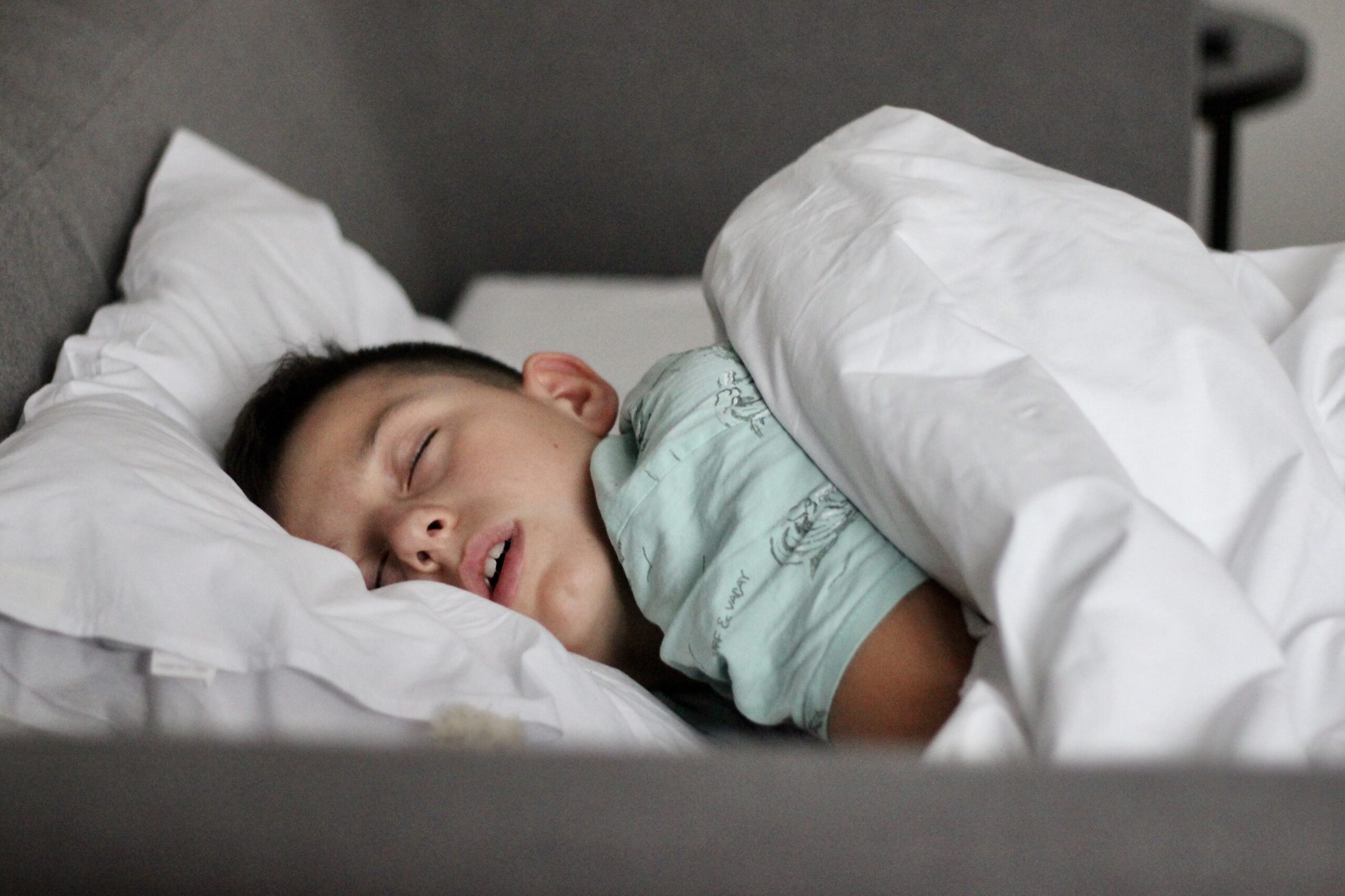
A child sleeps with their mouth open when something makes nasal breathing harder to sustain through the night — most often nasal obstruction (like enlarged tonsils/adenoids or allergies), a learned mouth-breathing habit, or, in some children, a combination of the two. It’s a pattern worth screening rather than ignoring, but a single observation doesn’t tell you why it’s happening.
This article is for general education and isn’t a substitute for an in-person evaluation.
Is It Normal for a Child to Sleep With Their Mouth Open?
If you’ve noticed your child sleeping with their mouth open, you’re not overreacting by wondering about it. Persistent open-mouth breathing during sleep is a recognized sign that pediatric providers pay attention to, because sustained mouth breathing is generally the body compensating for something rather than a random quirk. The more useful question isn’t “should I worry?” but “what’s actually contributing to this, and who’s the right person to help figure that out?”
What Actually Causes a Child to Sleep With Their Mouth Open?
There’s rarely one single answer, and it’s worth being cautious about assuming you already know the cause. Persistent open-mouth breathing in children can stem from several different contributors, sometimes more than one at once.
| Category | Examples | Why It Leads to Mouth Breathing |
|---|---|---|
| Nasal obstruction | Enlarged tonsils or adenoids, chronic allergies, sinus congestion, a deviated septum | Physically restricts nasal airflow, forcing the mouth open as a workaround |
| Habit | A mouth-breathing pattern that continues even after congestion has cleared | The body defaults to the pattern it’s used to, independent of current obstruction |
| Structural or anatomical factors | Jaw position, palate width, tongue posture | Can reduce available nasal or oral airway space, making nasal breathing less comfortable |
| Oral tissue restrictions | Tongue-tie or lip-tie, in some children | May contribute to altered tongue posture or feeding-related habits, but is not automatically the explanation |
It’s worth being direct about that last row: tongue-tie is sometimes mentioned online as an automatic explanation for mouth breathing, but that’s an oversimplification. A tongue-tie may be one contributing factor in some children and completely unrelated in others. Assuming it’s “the” cause without a proper evaluation can lead a family toward the wrong next step.
When Should Parents Not Worry?
Not every instance of open-mouth breathing needs a workup, and it’s worth being just as clear about this as about the warning signs. You can generally hold off on scheduling anything urgent if:
- The open-mouth breathing only happens occasionally — during a cold, a rough allergy week, or a particularly deep sleep cycle
- It resolves within a week or two once congestion clears
- It isn’t accompanied by snoring, gasping, or long pauses in breathing
- Your child otherwise wakes up rested, eats and speaks normally, and isn’t showing daytime fatigue or behavior changes
The pattern that warrants a closer look isn’t “did I see this once” — it’s “is this happening most nights, and is it accompanied by other signs.” A brief return of mouth breathing for a few nights after a cold clears is common and doesn’t, by itself, mean something structural is going on.
Does Mouth Breathing Actually Affect Facial Growth?
You may have seen terms like “long face syndrome” or “open bite” mentioned in passing on other sites without much explanation of why they happen. Here’s the actual mechanism: when a child’s mouth stays open to breathe, the tongue rests low in the mouth instead of pressing against the roof of the palate — which is where it normally provides gentle, continuous pressure that helps guide the width of the upper jaw during growth. A systematic review and meta-analysis of pediatric mouth-breathing studies found consistent associations between chronic mouth breathing and facial skeletal changes, including the jaw rotating backward and downward, a steeper bite plane, a narrower airway space behind the tongue and soft palate, and a tendency for the upper front teeth to tilt forward.
Because these changes happen gradually over months and years, they’re usually not something a parent notices on their own — it typically takes a provider specifically evaluating jaw and palate structure to catch the pattern early, before it becomes more pronounced.
Can Mouth Breathing Affect Speech?
Yes, and the connection is more direct than it might seem. Because nasal breathing supports the normal resting position of the tongue against the palate, chronic mouth breathing can contribute to altered tongue posture that affects how certain sounds are formed — this is part of why mouth breathing and orofacial myofunctional concerns (patterns involving the muscles of the mouth and face) are often evaluated together rather than separately. When a myofunctional component is identified, therapy aimed at retraining tongue posture and oral muscle function is sometimes recommended alongside addressing any underlying nasal obstruction.
Useful Observations to Share With a Provider
Because there are multiple possible contributors, the details you’ve noticed at home are genuinely useful clinical information — more useful, in many cases, than a single symptom on its own. Before an appointment, it can help to note:
- How often your child sleeps with their mouth open — every night, or only sometimes
- Whether it happens alongside snoring, restless sleep, or pauses in breathing
- Whether your child also breathes through their mouth during the day, not just at night
- Any history of chronic congestion, allergies, or frequent ear/sinus infections
- Daytime signs like fatigue, irritability, or trouble concentrating
- Whether a pediatrician or ENT has already evaluated tonsil or adenoid size
None of these observations diagnoses anything on their own. Together, they help a provider understand whether what you’re seeing looks more like an isolated habit or a pattern worth investigating further.
The Roles of the Dentist, Pediatrician, and ENT
Persistent mouth breathing sits at an intersection of dentistry, general pediatrics, and ENT medicine, and no single provider owns the full picture. Understanding what each one actually evaluates can save families time and confusion.
| Provider | What They Typically Evaluate | What They Are Not Positioned to Do |
|---|---|---|
| Dentist (airway-focused screening) | Oral and jaw structure, bite relationship, palate width, oral habits, screening for patterns that may warrant further evaluation | Diagnose sleep apnea, interpret sleep studies, or treat enlarged tonsils/adenoids |
| Pediatrician | General health history, growth, allergies, coordinating referrals, ruling out broader medical causes | Detailed structural/oral airway screening, which is more the dentist’s domain |
| ENT (otolaryngologist) | Tonsil and adenoid size, nasal obstruction, sinus issues, and structural airway diagnosis; can order or interpret a sleep study | Typically not the first stop for identifying oral/jaw-related contributors |
In practice, most children benefit from more than one of these perspectives, which is exactly why coordinated care — rather than one provider working in isolation — tends to produce a clearer answer.
Screening vs. Diagnosis: An Important Distinction
This distinction matters more than it might seem. Screening means gathering information and identifying whether a pattern looks like it warrants closer investigation. Diagnosis means confirming a specific medical condition, which typically requires a sleep study, direct examination by a physician, or specialist testing.
A dental airway screening can reasonably tell you: this pattern is worth a closer look, and here’s who else should be involved. It cannot, on its own, tell you: your child has sleep apnea or your child’s tongue-tie is causing this. Being clear about that distinction protects families from both false reassurance and unnecessary alarm, and it’s why a proper evaluation is framed as a process of investigation and coordination rather than an immediate treatment decision.
Why We Don’t Recommend Mouth-Taping for Children
It’s tempting to look for a fast home remedy once a pattern like this shows up, but mouth-taping and similar at-home interventions are not something we recommend for children. Taping a child’s mouth closed during sleep addresses the visible symptom without identifying — or safely managing — the underlying cause, and it introduces its own safety considerations for a child who may need to breathe through their mouth if their nose is genuinely obstructed. The more reliable path is a proper screening that looks at oral and jaw structure, breathing pattern, and relevant medical history together.
What an Airway and Sleep Screening Actually Involves
A dental airway screening starts with a conversation about what you’ve noticed at home — sleep patterns, snoring, daytime behavior, and relevant medical history — followed by a hands-on exam of jaw structure, palate width, tongue mobility, bite relationship, and oral posture. You should leave with a clear explanation of what was found, what it does and doesn’t tell us, and what happens next. If oral tissue restrictions or myofunctional patterns are identified, they’re addressed as part of that broader picture. If further evaluation is warranted, the next step is a specific referral — to a pediatrician, ENT, or sleep specialist — rather than a vague “keep an eye on it.”
Learn more about our approach on our Airway & Sleep page, and if tongue-tie or oral muscle function comes up during the evaluation, our Frenectomies & Myofunctional Therapy page covers that service in more depth.
Frequently Asked Questions
Does my child sleeping with their mouth open always mean something is wrong? No. Occasional open-mouth breathing during a cold or allergy flare is common and usually resolves on its own. A persistent, nightly pattern is what’s worth having screened.
Can mouth breathing affect my child’s health? Yes, when it’s persistent. Ongoing mouth breathing has been associated with poorer sleep quality, dry mouth and higher cavity risk, daytime behavior and concentration changes, and — over time — changes to facial and jaw growth as covered above. Occasional, short-term mouth breathing during illness is not typically a health concern.
Does mouth breathing cause long face syndrome or an open bite? It’s associated with these changes, largely because it alters resting tongue posture during a period when the jaw and palate are still developing — though it isn’t guaranteed to happen in every child who mouth breathes, and severity varies.
Can mouth breathing cause speech problems? It can contribute to altered tongue posture that affects certain sounds, though speech difficulties have several possible causes worth ruling out.
Is tongue-tie the cause of my child’s mouth breathing? Not necessarily. Tongue-tie may be a contributing factor in some children, but it’s one of several possible contributors, not an automatic explanation. A proper evaluation looks at the whole picture rather than assuming a single cause.
Should I try mouth-taping at home first? We don’t recommend it. It addresses the symptom without identifying the underlying cause, and it isn’t something we advise trying without professional guidance.
Who should I see first — a dentist, pediatrician, or ENT? Any of the three is a reasonable starting point, since they each evaluate different pieces of the picture. Many families find it helpful to start with whichever provider they already see regularly and let that visit guide the next referral.
How is mouth breathing actually treated in children? Treatment depends entirely on the cause. It may involve allergy or congestion management, ENT evaluation of tonsils and adenoids (with surgery considered only when indicated), orthodontic or airway-focused dental treatment if jaw or palate structure is contributing, or myofunctional therapy if altered tongue posture or oral muscle patterns are identified. There’s no single treatment that applies to every child.
What’s the difference between a screening and a diagnosis? A screening identifies whether a pattern looks worth investigating further. A diagnosis confirms a specific condition, typically through a sleep study or specialist examination. A dental airway screening is the former, not the latter.
Getting Started
If your child regularly sleeps with their mouth open, especially alongside snoring, restless sleep, or daytime fatigue, a proper screening is a reasonable next step — not because it’s an emergency, but because understanding the contributing factors early tends to make everything that follows more straightforward. Visit our Pediatric Preventative Care page to learn more about how we approach children’s oral and airway health, or contact us to schedule an airway and sleep screening.
References
- Cleveland Clinic. Should You Breathe Through Your Nose or Mouth? Cleveland Clinic Health Library. https://health.clevelandclinic.org/breathe-mouth-nose
- Effects of mouth breathing on facial skeletal development in children: a systematic review and meta-analysis. PubMed / BMC Oral Health, PMC, National Library of Medicine. https://www.ncbi.nlm.nih.gov/pmc/articles/PMC7944632/